Eighty-three percent of marketers report that customers now expect two-way conversations, yet 69% acknowledge difficulty in responding promptly. According to Salesforce’s latest State of Marketing report, this gap represents a critical challenge for the industry.
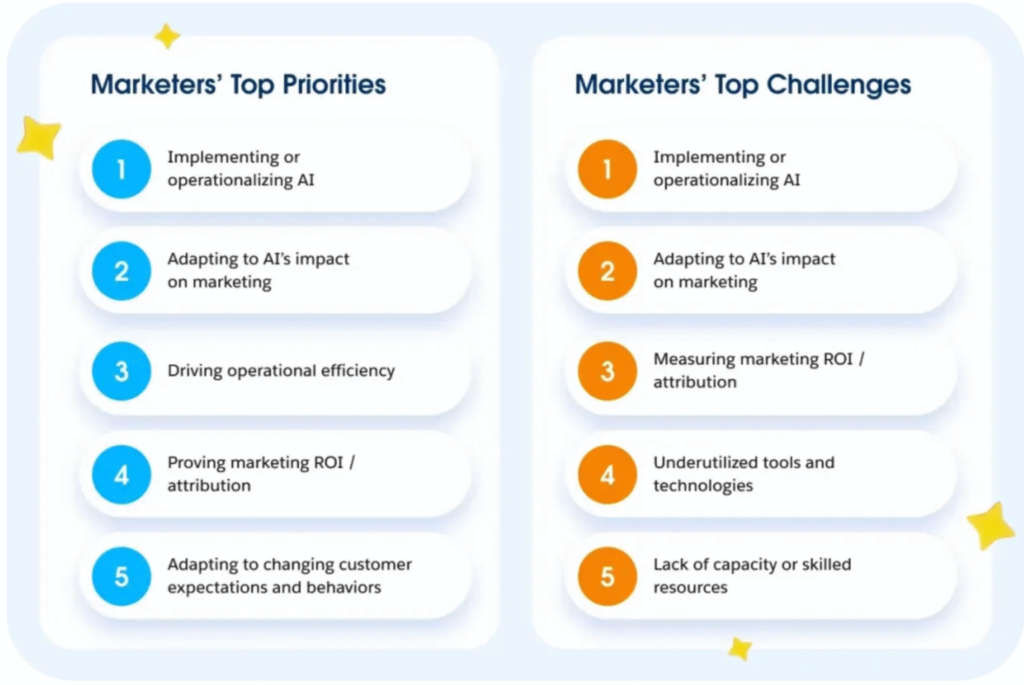
The AI-driven transformation of marketing is already underway. A global survey of nearly 4,500 marketers shows that customer expectations are rising faster than teams can keep up. While 75% of organizations have adopted at least one form of AI, implementation still lags behind strategic intent.
This challenge is no longer confined to the CMO’s office—it’s a frontline marketing reality.
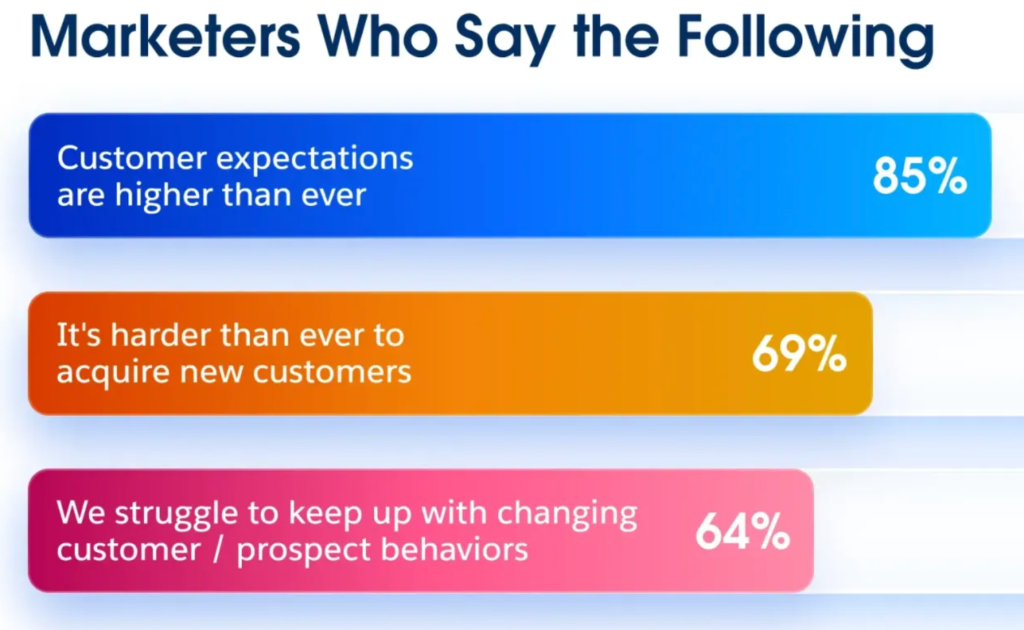
According to the report, three out of four marketing teams are using AI in some capacity. On paper, this suggests a sweeping transformation—but in reality, many teams are still layering AI onto fragmented data and legacy workflows.
Marketers see AI as a way to reclaim significant time each week. That regained time isn’t just about working faster; it opens up space for strategy, creative thinking, and deeper customer insights. However, this potential only becomes real when marketers have the skills to guide, interpret, and manage AI effectively.
Data analysis and AI fluency are rapidly becoming essential skills. Marketers who cannot interpret data or orchestrate AI tools risk falling behind.
Marketers trust AI to talk to customers
Eighty-one percent of marketers now report trusting AI to handle customer inquiries—a milestone moment. AI agents can deliver 24/7 responsiveness at a scale human teams alone cannot match.
But speed alone isn’t enough. Meaningful conversations require AI to be fueled by unified, contextual customer data.
Salesforce’s research underscores a lingering challenge: many marketing teams still lack complete access to customer data across departments.
When service, sales, and commerce data remain siloed, personalization suffers. AI cannot accurately predict customer behavior or suggest the next-best actions without a complete view of the customer.
The result: personalization efforts often fall short. Eighty-four percent of marketers admit their campaigns still feel generic. This highlights a key insight: AI alone cannot deliver personalization—connected, high-quality data does.
Some progress is underway. More marketers are leveraging predictive behavior modeling to segment audiences. Yet these capabilities depend on strong data architecture, governance, and cross-functional alignment.
Agentic marketing is moving to implementation
The strongest sign that agentic marketing is taking hold isn’t theoretical—it’s practical. Sixty-one percent of marketers report that their organizations are either experimenting with or fully deploying AI agents. Autonomous systems are no longer side projects; they are becoming part of live workflows.
This change is strategic, not just tactical. Sixty-eight percent of marketers consider generative AI critical to their overall marketing strategy, signaling that AI is evolving from a campaign tool into core marketing infrastructure.
Autonomy, however, hinges on timing and context. Sixty-four percent of marketers say real-time data activation is essential to their success. Agentic systems cannot rely on delayed reporting—they need current signals to trigger next-best actions, adjust journeys, and personalize responses as interactions unfold.
A strong data foundation also separates leaders from laggards. Fifty-seven percent of high-performing marketing teams report having a unified customer data platform, giving AI agents the visibility they need to act with awareness rather than guesswork.
Taken together, these numbers point clearly in one direction: marketing is evolving toward systems that do more than assist humans—they operate alongside them, continuously triggering journeys, adjusting messaging, and optimizing interactions.
The opportunity isn’t merely automation; it’s coordinated autonomy, powered by real-time data and a unified view of the customer.
Marketing is aligning with revenue
Revenue accountability is no longer aspirational—it is measurable. According to Salesforce, 83% of high-performing marketers report having a clear view of their impact on the sales pipeline, compared with far lower visibility among underperforming teams.
This alignment is structural. More than half of marketers say their top KPIs now directly tie to revenue growth and pipeline contribution, rather than engagement metrics alone. At the same time, 60% cite improving customer journey orchestration across marketing, sales, and service as a top priority, highlighting the need for end-to-end visibility.
Data integration is emerging as the defining factor. Fifty-seven percent of high-performing teams have a unified customer data platform, providing the visibility needed for closed-loop reporting, accurate attribution, and stronger credibility with finance and executive leadership. Marketing is no longer measured by output alone—it is evaluated on its contribution to growth.
Personalization remains the hardest challenge
While revenue alignment is accelerating, personalization is still lagging. Eighty-four percent of marketers admit their campaigns feel generic, despite years of investment in segmentation and automation.
The gap isn’t a lack of awareness. Seventy-eight percent of marketers say they need more personalized content than they can currently produce. At the same time, 64% cite real-time data activation as critical to success—yet many teams still lack the infrastructure to deliver it consistently.
Fragmented data remains a major barrier. Only 57% of high-performing teams report having a unified view of customer data, leaving many marketers unable to personalize campaigns with full context. AI can scale content production, but without strong data governance and connected systems, automation simply accelerates generic output.
The result is a paradox: the tools for hyper-personalization are widely available, yet the operational foundation to execute at scale remains uneven.